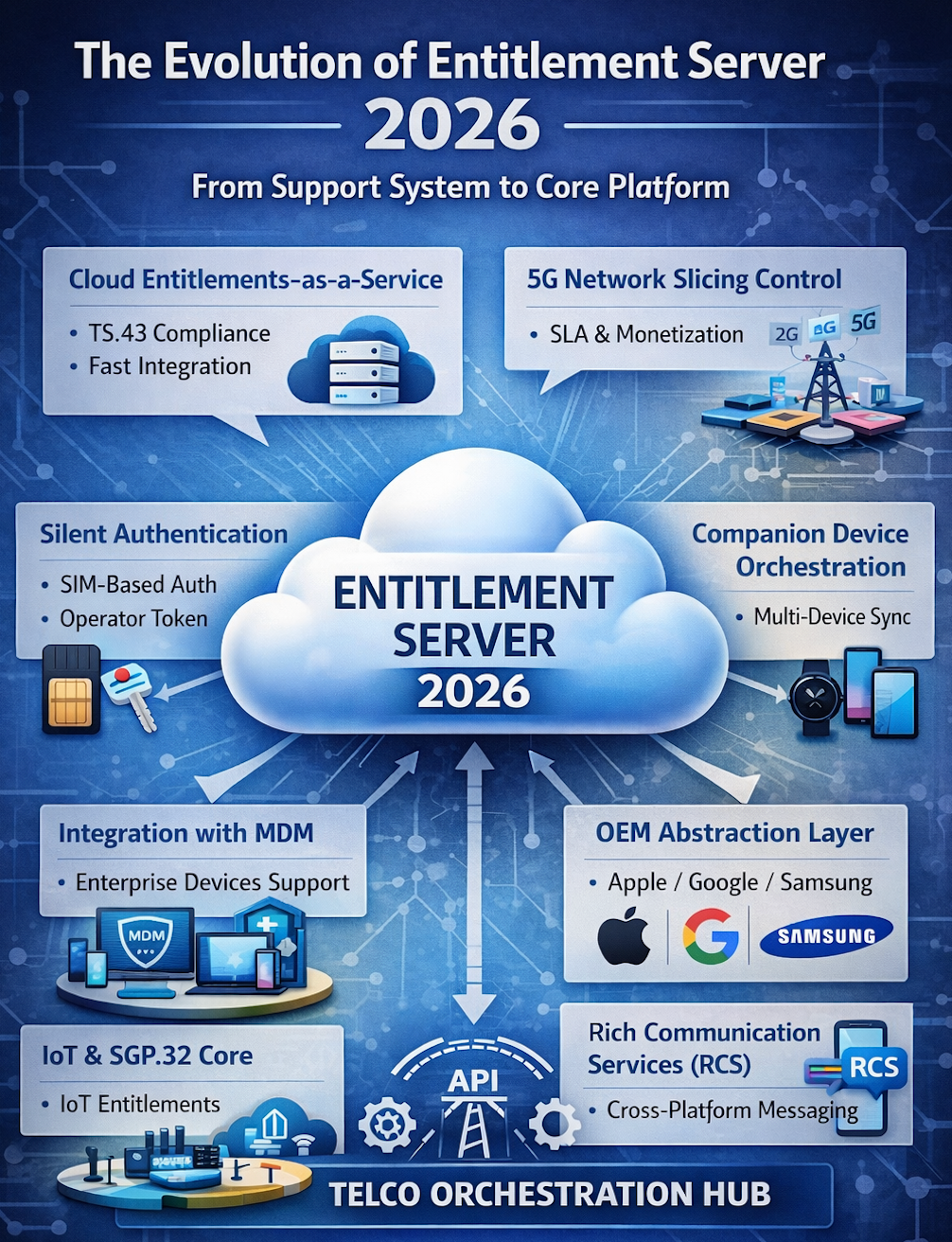
The legacy Entitlement Server — designed for static device configuration in 2G and 3G eras — is structurally insufficient for 5G Standalone and multi-device ecosystems. By 2026, the ES must be a cloud-native, policy-driven, real-time decision platform. Five core capabilities define what that means in practice.
1. Cloud-Native ES as a Service (EaaS)
Leading operators are already there:
- T-Mobile runs ES workloads on AWS
- Vodafone on Azure
- DISH was born-cloud
Cloud-native ES delivers 40-60% cost reduction compared to on-premises deployments, plus the elasticity to handle subscriber growth and peak entitlement decision volumes without capacity pre-provisioning. Operators still running on-premises ES are accumulating architectural debt that compounds with every 5G SA launch.
2. 5G Network Slicing Control
The ES becomes the policy and commercial gatekeeper for network slice access. Slice eligibility decisions — which subscribers can access which slices, under what SLA constraints, at what commercial terms — must be made at the speed of network events. The ES is the only system positioned to combine the following in a single real-time decision:
- subscription state
- device capability
- location
- SLA policy
This is not optional for any operator with a 5G SA monetisation strategy.
3. Silent Authentication and Operator Token
GSMA Open Gateway defines a set of standardised network APIs for third-party developers. The most valuable of these is SIM-based silent authentication — user identity verified by the network using EAP-AKA credentials, without SMS OTP. The ES issues the operator token that enables this flow. Silent authentication eliminates OTP friction from onboarding and transaction flows across every third-party app that integrates the Open Gateway API. The ES is the trust anchor that makes this possible.
4. Multi-Device Orchestration
Consumer, automotive, and enterprise device fleets all require entitlement management. The new ES architecture treats these as a unified policy problem — not three separate provisioning systems. A single policy engine governs entitlements across a subscriber’s:
- smartphone
- connected car
- enterprise laptop
- wearables
Cross-device consistency reduces support load and enables new plan constructs (shared data pools, device-class SLAs) that per-device systems cannot deliver.
5. Enterprise and IoT Extension
The following extend the ES reach beyond the consumer base:
- Enterprise mobility management (MDM) integration: Enterprise customers expect policy enforcement integrated with their MDM platform.
- SGP.32 IoT eSIM support: IoT deployments at scale require the remote provisioning and profile lifecycle management that SGP.32 enables — and the ES is the logical orchestration layer above the eIM for operators managing IoT connectivity commercially.
The Architecture Imperative
These five capabilities are not independent features to be added incrementally. They share a common architectural foundation:
- Cloud-native infrastructure
- A real-time policy engine
- Standardised interfaces to the rest of the telco stack
Operators that architect for all five from the outset will find the capabilities compound — silent auth enables API economy revenue, multi-device orchestration enables slice monetisation, cloud-native infrastructure enables IoT scale. Operators that treat them as separate projects will find integration complexity grows faster than capability.